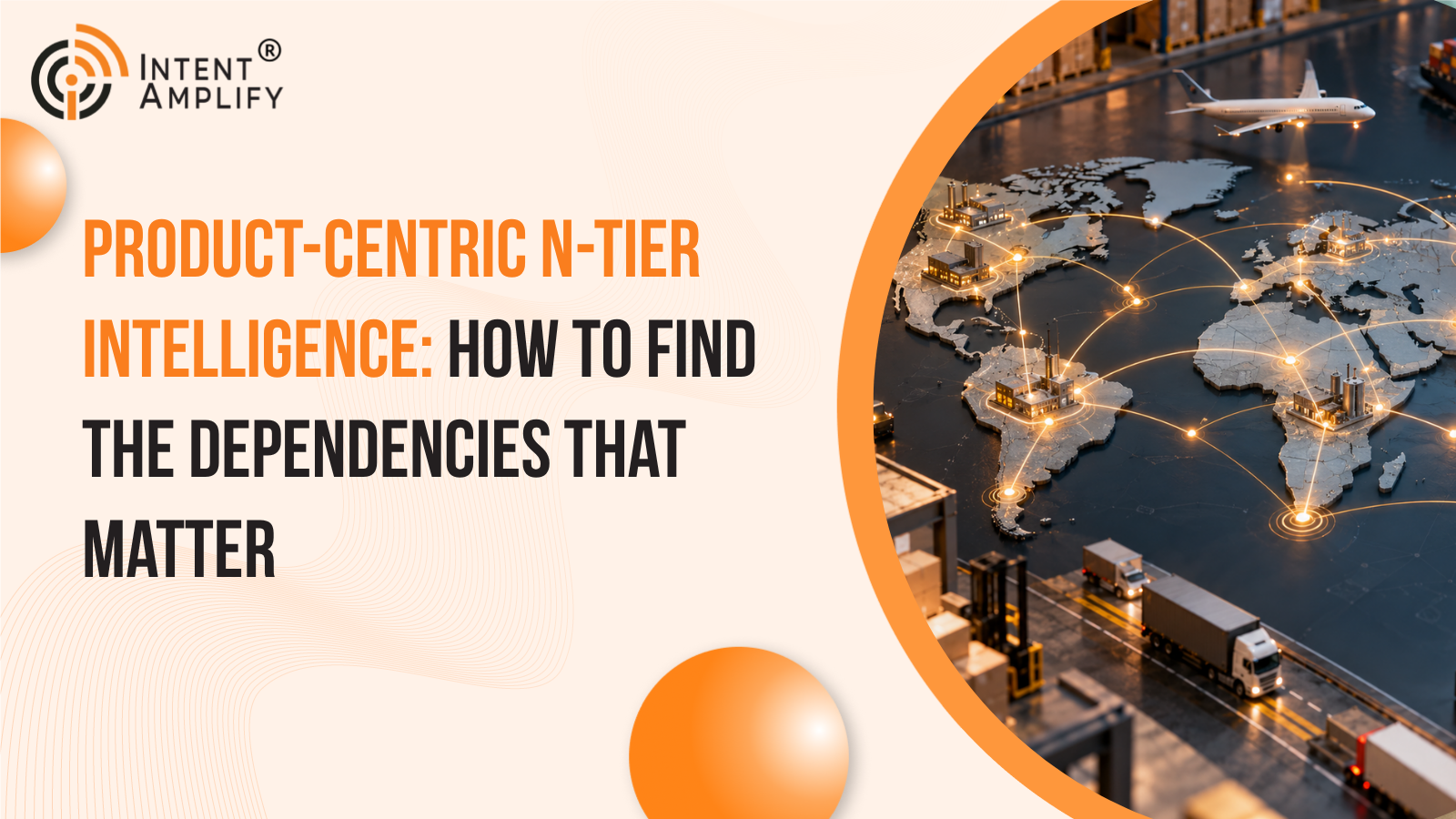
The most useful supply chain map is not necessarily the largest one.
For procurement and supply chain leaders, a graph containing thousands of supplier relationships can create the appearance of transparency while leaving the central business question unanswered: which dependencies matter to the products and commitments the organization cannot afford to lose?
That is the purpose of product-centric N-tier intelligence. Instead of starting with the supplier universe, it starts with business criticality and works backward through the materials, sites, suppliers, and upstream relationships supporting a product.
Sphera’s 2026 discussion of N-tier visibility makes this distinction explicit: traditional relationship graphs can show who is connected to whom but may struggle to answer which products are at risk, where hidden dependencies exist, what the business impact could be, and which action should come first.¹
The shift is from network completeness to decision relevance.
Start with the Product, Not the Supplier Universe
A product-centric model begins with something the business already understands: a high-revenue product, a regulated product line, a constrained material, a strategic customer commitment, or a manufacturing process with few alternatives.
From there, teams trace the suppliers, sites, materials, and upstream relationships that support the outcome.
The advantage is focus. Instead of treating every node as equally important, the organization can prioritize relationships based on business criticality.
Supply Chain Management Review reported in March 2026 that procurement teams are increasing attention on Tier-2 suppliers as tariffs, volatility, and compressed launch cycles expose the limits of Tier-1 oversight.²
A product-centric approach gives that deeper visibility a business reason.
Find Hidden Concentration
The most dangerous dependency is often the one that contradicts what the sourcing model appears to show.
A company may have two direct suppliers for a component but discover that both depend on the same Tier-2 producer. Multiple products may rely on the same specialty material. Several upstream suppliers may operate in one exposed geography.
These patterns create concentration risk that Tier-1 supplier counts cannot reveal.
Research published in 2026 on multi-layered supplier risk assessment reinforces the importance of combining several risk dimensions when evaluating supplier resilience rather than relying on a single supplier-level measure.³
The executive question is therefore not simply “How many suppliers do we have?” It is “Where do our supposedly independent supply paths converge?”
Connect Risk to Propagation
A disruption becomes decision-relevant when leaders understand how it can propagate.
The chain is:
event → upstream supplier/site → material or component → direct supplier → product → operational or commercial outcome.
This chain helps teams distinguish a severe event with limited relevance from a moderate event threatening a critical supply path.
CIPS reported in July 2026 that geopolitical disruption, inflation and input-price pressure, and cyber risk remained prominent supply-chain concerns.⁴ The value of N-tier intelligence is not simply detecting those risk categories. It is connecting them to the products and dependencies that determine consequence.
Prioritize Response
Once exposure is connected to products, the organization can compare mitigation options.
- Can inventory bridge the disruption?
- Is an alternate source already qualified?
- How long would supplier qualification take?
- Can production be shifted?
- Can a specification change reduce dependence?
- Does the issue require supplier engagement, sourcing action, compliance review, or executive escalation?
This is where N-tier intelligence becomes a decision capability rather than a visualization capability.
Executive Readiness Framework for Product-Centric N-Tier Intelligence
| Dimension | Executive Question | Why It Matters |
|---|---|---|
| Product Criticality | Which products and commitments justify deeper intelligence? | Prevents the program from becoming an unbounded mapping exercise. |
| Supplier-Product Linkage | Can products be reliably connected to suppliers, materials, and sites? | Establishes the dependency chain needed for impact analysis. |
| Sub-Tier Confidence | Is each upstream relationship verified, inferred, stale, or unknown? | Keeps uncertainty visible in decision-making. |
| Concentration Analysis | Can teams identify shared upstream nodes across suppliers and products? | Reveals hidden single points of failure. |
| Risk Monitoring | Are relevant financial, geopolitical, cyber, operational, regulatory, and natural-hazard signals connected to the dependency? | Turns external events into business context. |
| Mitigation Workflow | Are alternatives, constraints, owners, and escalation paths defined? | Converts intelligence into action. |
| Outcome Measurement | Can leaders measure decision speed, mitigation readiness, and operational impact? | Connects the capability to performance. |
A Five-Step Product-Centric Workshop
Step 1: Select the product.
Choose a product where disruption would create a meaningful operational, commercial, or regulatory consequence.
Step 2: Build the dependency chain.
Connect the product to critical components, materials, direct suppliers, upstream suppliers, and sites. Record the source and confidence for each relationship.
Step 3: Find convergence.
Look for nodes shared by multiple direct suppliers or products. Include geographic, process, material, and logistics concentration.
Step 4: Test a disruption.
Choose one upstream node and assume it becomes unavailable. Estimate time to impact, inventory coverage, alternate capacity, qualification constraints, and affected customers or operations.
Step 5: Define action.
Document the first investigative action, mitigation threshold, decision owner, and escalation path.
The workshop converts a static network into a decision model.
What a Useful Output Looks Like
The output of product-centric analysis should be concise enough for action.
For each critical product, a decision brief can show the essential upstream dependencies, shared concentration points, confidence level, active risk signals, inventory coverage, alternate-source status, and named response owner.
This is more useful than asking an executive to interpret a dense network graph. The graph can remain available for investigation, while the decision brief summarizes what matters now.
The same brief can support sourcing reviews and tabletop exercises. As new relationships are validated or new risks emerge, the team updates the decision context rather than rebuilding the analysis from scratch.
Why Decision Context Matters More Than Alert Volume
Risk-monitoring systems can generate a large number of supplier and external-event signals. But an alert is only useful when the organization can determine what is exposed and what to do.
ISM and Amazon Business reported in July 2026 that 71% of surveyed organizations said balancing cost and risk now drives procurement strategy, while only 45% said they were prepared for supply-chain disruptions and 65% still relied on manual reporting to gather supply-chain data.⁵
Product-centric N-tier intelligence can narrow that decision gap by linking the alert to a critical product, trusted dependency, concentration point, mitigation option, and accountable owner.
The practical standard is simple. Every new relationship, signal, or workflow should help answer at least one of four questions: What is exposed? How confident are we? What can we do? Who owns the next action?
Where the N-Tier Webinar Fits
Unlocking N-Tier Intelligence for Better Supply Chain Decisions examines the move from supplier-centric visibility to product-centric intelligence.
The on-demand discussion addresses hidden dependencies, concentration risk, disruption propagation, business impact, and action prioritization. For supply chain, procurement, sourcing, risk, and operations leaders, it provides a practical framework for deciding where deeper-tier intelligence creates business value.
Watch the on-demand webinar: Unlocking N-Tier Intelligence for Better Supply Chain Decisions.
FAQs
What is product-centric N-tier intelligence?
It is an approach that begins with a critical product or business outcome and traces the suppliers, sites, materials, and upstream relationships supporting it.
How is it different from supplier-centric mapping?
Supplier-centric mapping emphasizes the network of relationships. Product-centric intelligence emphasizes which relationships can materially affect a defined product or business outcome.
How does it reveal hidden concentration?
It tests whether multiple direct suppliers or products converge on the same upstream source, geography, process, material, or logistics dependency.
What should a decision brief include?
A useful brief includes critical dependencies, relationship confidence, concentration points, active risk signals, inventory coverage, alternate-source status, mitigation constraints, and a named response owner.
Conclusion
The value of N-tier intelligence is not measured by how many nodes appear on a network map.
It is measured by whether leaders can identify the dependencies behind critical products, distinguish verified relationships from uncertain ones, see where supply paths converge, understand how disruption could propagate, and choose a mitigation while options remain available.
Product-centric intelligence provides that discipline. It turns deeper-tier visibility from a mapping exercise into a decision model built around business consequence.
Connecting Supply Chain Innovation with Enterprise Decision Makers
For organizations bringing supply chain intelligence, procurement, risk, or resilience solutions to market, Intent Amplify helps translate technical capabilities into executive-ready demand generation.
Our work supports B2B technology brands with content strategy, audience intelligence, executive messaging, account-based engagement, and pipeline activation designed for complex enterprise buying cycles.
If your team is looking to engage enterprise supply chain, procurement, operations, or risk leaders with sharper market narratives and more decision-relevant content, connect with Intent Amplify.
References
1. Sphera, Why Traditional N-Tier Visibility Falls Short — and What Comes Next, 2026
2. Supply Chain Management Review, How Procurement Teams Are Managing Tier 2 Suppliers to Lower Costs and Improve Resilience, March 2, 2026
3. International Journal of Physical Distribution & Logistics Management, From Risk to Resilience: A Multi-Layered Framework for Supplier Risk Assessment to Strengthen Supply Chain Resilience, 2026
https://www.sciencedirect.com/org/science/article/pii/S0960003526000206
4. CIPS, Q2 2026 CIPS Pulse Survey: Supply Chain Risk Results, July 2026
https://1prd-dxp.cips.org/knowledge-and-insight/articles/q2-2026-pulse-results
5. Institute for Supply Management, ISM and Amazon Business Research Finds Most Organizations Unprepared for Supply Chain Disruption Despite Strategic Shift, July 2026