
The Buying Committee Is Not a Contact List
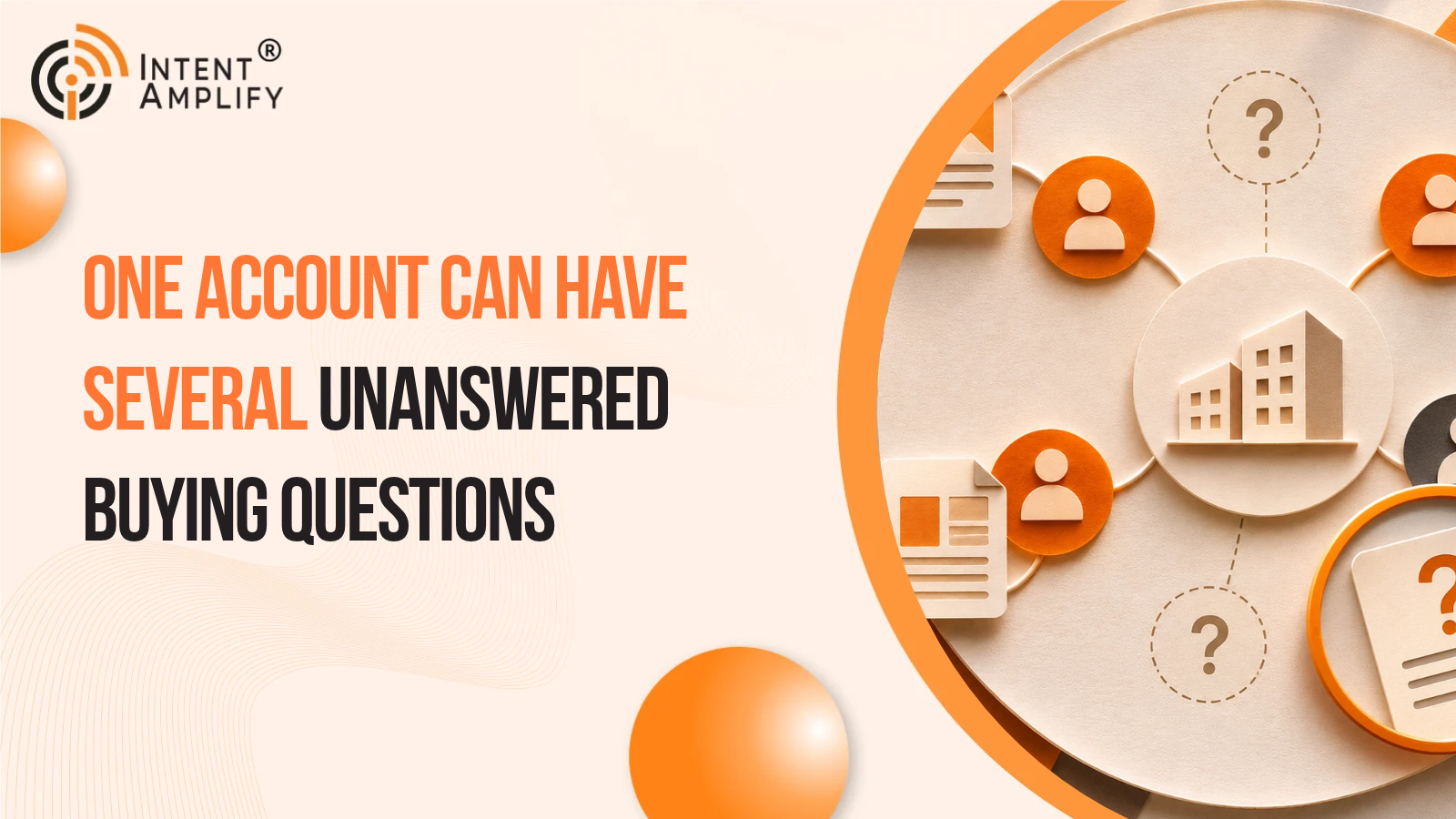
Imagine three contacts from a target software company request three different resources. That may be valuable engagement, but it still does not prove that those contacts make decisions together or that all relevant functions have been reached. Contact counts describe records; committee coverage describes a relationship between roles, content questions, and a defined purchase decision. That relationship needs evidence before a campaign report can make a strong claim.
6sense's November 2026 global buyer research describes how buyers often know vendors before a formal evaluation begins [5]. The reported findings concern surveyed journeys, not the intentions of a named account. Rather than sending a meeting request to every content reader, a marketer should ask what information each person actually requested and which meaningful decision questions still lack a response.
The Seven-Question Coverage Card
Question 1: Which Decision Are We Helping People Make?
Write the likely organizational choice in one sentence. Is the account comparing a new cloud platform, considering an application migration, or assessing a change in data practices? Different decisions require different types of assurance. A single standard persona map will not capture every situation. Record the offer, the reason for targeting the account, and the boundaries of what Marketing currently knows.
Question 2: Which Roles Are Verified, Not Merely Expected?
The presence of a familiar title is not proof of committee membership. Confirm employer, responsibility, current title, and available source date under the approved audience rules. Intent Amplify's Buyer Intelligence offering supports defining and validating accounts and roles [1]. A source-backed record can help identify potential gaps, but an unknown stakeholder must remain unknown until independently established.
Question 3: Which Question Does Each Asset Answer?
A short executive brief should answer why a change may matter. A practical checklist can address feasibility. A comparison guide can clarify trade-offs, while an implementation outline may help the operational team prepare for delivery. Content should be matched to the decision question, not just inserted into a generic cadence. Forrester's September 2026 discussion of changing partner demand programs argues that buying-group-aware engagement is more relevant than relying only on individual lead capture [4].
Question 4: What Did the Person Actually Do?
Record the source event, content title, date, channel, and observed action. Google Analytics recommends distinct events for lead submission and qualification, but these depend on actual implementation and separate definitions [7]. A resource request is not a recorded budget, procurement mandate, or buyer consensus. If the person has voluntarily supplied a question, preserve that exact context for an appropriate reply.
Test One Role-to-Content Match
Take one genuine content response and compare it with the role's verified responsibility, the resource's purpose, and the next reasonable educational step. Use the result to improve the next distribution decision.
Review the Managed Demand Generation Approach
Question 5: Where Has the Account Not Engaged?
Keep a list of roles that matter to the hypothesized decision but lack observed interaction. These blanks are not failure labels. They are a way to avoid overclaiming and to design future assets that answer neglected questions. A CMO might have received a business case while the deployment team has received no practical guide. That is a content-planning observation, not evidence that the deployment team rejects the offer.
Question 6: What Follow-Up Is Proportionate?
A resource reader may be interested in a related article, while someone asking a practical implementation question may appreciate specialist guidance. A meeting should be offered when useful, not as an automatic response to every download. Intent Amplify's Managed Demand Generation and Pipeline Activation services describe coordinated delivery and contextual handoff [2], [3]. A handoff should preserve what the person actually said rather than presenting inferred intent as a buyer statement.
Question 7: Could Another Reviewer Rebuild the Result?
Choose a reported engaged role. Can a colleague locate the verified account, source event, role category, and rule used to count the record? If the same person submitted two forms, does the scorecard still count one engaged person? If the account is a subsidiary, is it counted under a clear hierarchy rule? A reproducible result matters more than a confident-sounding headline number.
A Three-Line Account Coverage Note
Line 1, Known Role and Account: State what was actually verified, including the source and date.
Line 2, Observed Content Interest: Name the resource and the original event, without exaggerating its meaning.
Line 3, Coverage Question: Identify the next stakeholder question or a buyer-requested next action.
This note gives Sales a useful starting point and avoids assigning a whole committee's intent to an individual.
Forrester's 2026 commentary on digital-native buyers highlights demand for self-guided information in accessible formats [6]. Content Marketing Institute's 2027 research likewise identifies relevance, quality, and trust as concerns among surveyed marketers [8]. These observations cannot establish results for Intent Amplify clients. They are reasons to design useful material and verify what readers actually do with it.
A Worked Example: An Account With Uneven Content Coverage
Consider a fictional enterprise cloud vendor targeting a financial services company. The source list contains an ABM Director, a verified IT Manager, and a Finance Lead, but the campaign has only one recorded interaction: The IT Manager requested a security and integration checklist. The contact's title and request are useful evidence. They do not establish that the three people are collaborating, that the Finance Lead has reviewed a proposal, or that the account has set a buying timeline. The honest account summary states one engaged verified role, two other eligible contacts if their identities and contact-use conditions are confirmed, and no recorded buyer request for a commercial discussion.
A better next move is not to broadcast a meeting request across the account. Marketing can review whether a business-value brief and cost-planning worksheet genuinely answer different questions. Any permitted distribution should be measured separately. If the Finance Lead later asks for implementation cost assumptions, the team can add that direct question to the evidence trail. Sales then has a clearer basis for deciding whether to offer a conversation, without being told that the committee has already reached consensus. This is an instructional example, not a claim about a real customer or observed campaign result.
The Intent Amplify Perspective
Intent Amplify can be evaluated for account-role research, managed role-relevant content activation, and evidence-rich next-step handoffs [1], [2], [3]. The important distinction is between an eligible person receiving relevant information and a buyer group making a verified commercial decision. The former can be described with appropriate evidence; the latter requires the group's own actions and the client's Sales process.
The most useful account question is not simply how many contacts appeared. It is what those people needed to learn, what the record genuinely shows, and which buying questions remain unanswered.
Evidence Notes and References
Numbered citations identify the sources supporting particular statements. Official Intent Amplify service pages establish published offering scope, not verified client outcomes. Buyer and marketer survey findings retain their publisher, sample, and methodology boundaries. Proposed tests and examples are editorial guidance rather than results observed at a customer. Sources reviewed November 16, 2026.
- Intent Amplify, Buyer Intelligence | Published Service Scope. https://www.intentamplify.com/solutions/buyer-intelligence
- Intent Amplify, Managed Demand Generation | Published Service Scope. https://www.intentamplify.com/solutions/managed-demand-generation
- Intent Amplify, Pipeline Activation | Published Service Scope. https://www.intentamplify.com/solutions/pipeline-activation
- Forrester, AI Has Changed B2B Buying: Partner Demand Programs Must Follow | September 21, 2026. https://www.forrester.com/blogs/ai-has-changed-b2b-buying-partner-demand-programs-must-follow/
- 6sense, 2026 Global B2B Buyer Experience Research Release | November 2, 2026; Survey of 4,611 Buyers. https://6sense.com/news/6sense-research-finds-that-vendors-need-to-be-known-and-preferred-before-the-buying-journey-begins
- Forrester, Digital Natives Are Rewriting B2B Buying | April 24, 2026. https://www.forrester.com/blogs/digital-natives-are-rewriting-b2b-buying-and-its-impacting-your-revenue-performance/
- Google Analytics Help, Recommended Lead-Generation Events | Official Documentation. https://support.google.com/analytics/answer/9267735?hl=en
- Content Marketing Institute, B2B Content and Marketing Trends: Insights for 2027 | November 4, 2026; Survey of 861 B2B Marketers. https://contentmarketinginstitute.com/b2b-research/b2b-content-marketing-trends-research