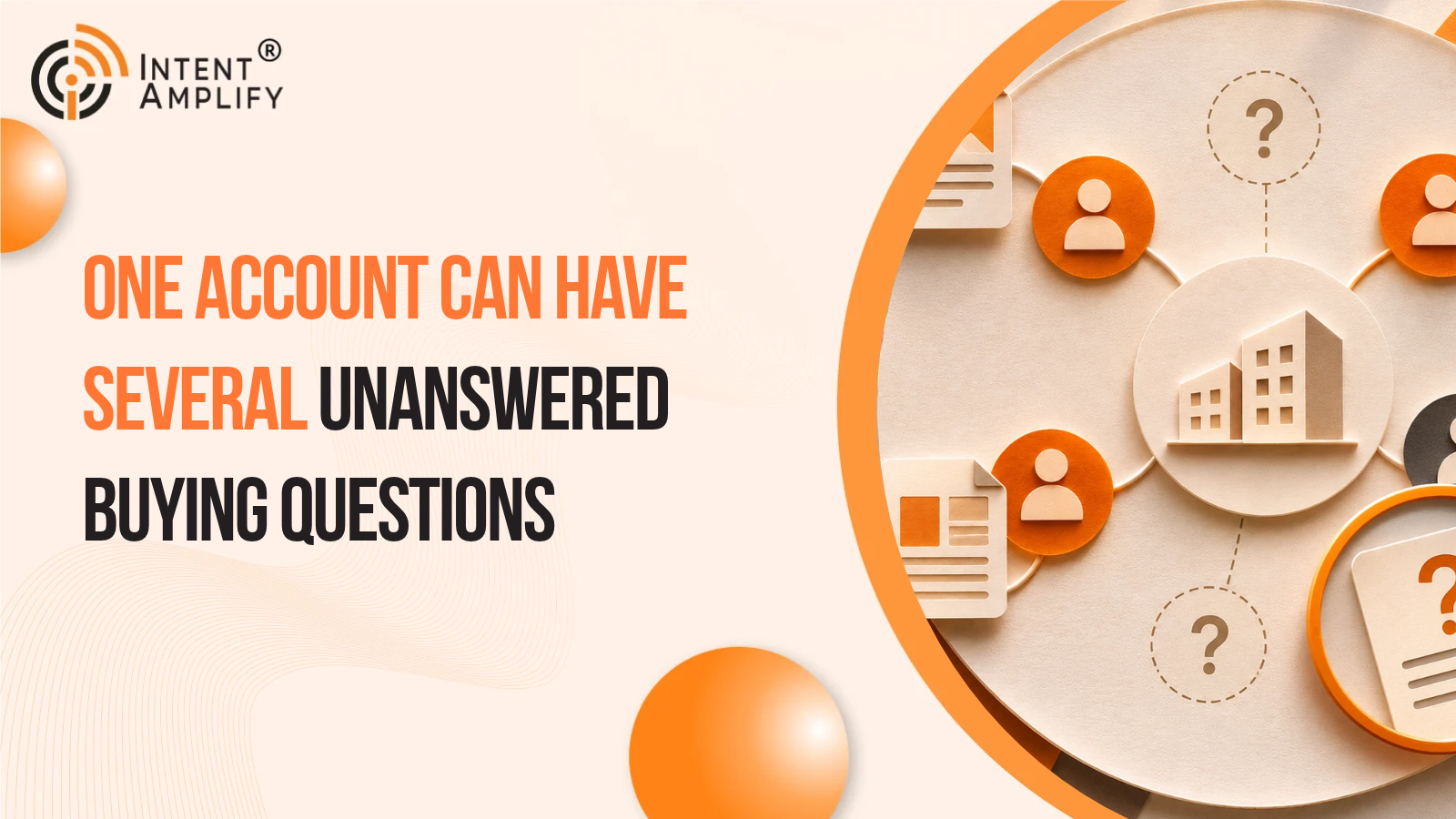

One Strong Contact Can Still Leave the Buying Committee Unmapped
A person requests a fintech product demonstration, asks two thoughtful questions, and shares a document with colleagues. This is meaningful engagement. It does not prove that everyone who must support a purchase has reviewed the idea. In financial-services technology, a person who understands an operational problem may still need input from Finance, Security, Legal, Risk, Procurement, and the team that would own implementation.
The broader 2026 research supports caution around early preferences. In its 2026 B2B Buyer Experience research, 6sense reports that buying groups often hold different vendor preferences before direct seller contact and that category justification can be a difficult step [1]. Those results describe a surveyed B2B population, not a verified attribute of a particular fintech opportunity. The useful lesson is that a respected champion may be the start of a decision map, not the map itself.
The Seven-Question Fintech Buyer Card
For each priority company, prepare a short, reviewable record. The goal is not to assign an invented committee to an account. It is to ask the next question that can establish whether the right people have relevant information. The seven checks below create a card that Marketing, Product Marketing, and Sales can read without a complex scoring model.
Question 1: Which Financial Workflow Is Being Considered?
Specify the exact business activity the product could support, such as merchant settlement, identity checks, loan servicing, financial reporting, or account onboarding. Do not blend payments infrastructure and lending workflows into one generic "fintech transformation" story. A product's feature list is not the same as the customer's stated problem. Capture both separately and mark the business problem as confirmed only when the buyer has actually expressed it.
Question 2: What Does the Contact Know, and What Is Still Assumed?
Document the original question or request, the person's known professional role, and any stated evaluation responsibility. If a Director of Digital Banking asks for an integration document, write precisely that. Do not translate the request into "the bank has selected a digital modernization initiative" unless there is separate evidence. A small amount of accurate context is more valuable than a confident story built from a title.
Question 3: Which Independent Review Could Be Relevant?
Financial institutions may apply due diligence to service providers, but the nature of that review varies by arrangement and institution. In November 2026, the OCC confirmed that the comment period for proposed Interagency guidance on third-party risk management had been extended through December 16. The proposal remained a proposal, not a new binding obligation [2]. The practical content question is whether a vendor can explain service boundaries and make available appropriate information for a buyer-led assessment.
Question 4: Is the Market Signal About Category Interest or Vendor Selection?
Payments adoption trends can signal broader category activity without proving a named institution intends to buy anything. The Federal Reserve publishes FedNow volume and value statistics for the service, with data updated in October 2026 [3]. Those figures tell a reader about network activity. They do not reveal the plans of a particular bank, software provider, or account executive. Keep market data in its proper place: Context for segment research, not prospect intent evidence.
Question 5: Which Questions Belong to Finance or Procurement?
A Technology Leader may be pleased with a demonstration while Finance still needs to understand operating cost, investment scope, and contractual exposure. G2's 2026 software buyer research emphasizes the significance of review and approval steps after shortlist selection [4]. Its findings are general B2B software survey results and should inform the design of a helpful business-case worksheet rather than serve as a fintech-specific approval statistic.
Question 6: Can We Trace the Original Engagement?
Record the requested content, date, channel, source identifier, qualification result, and contact preferences. A form submission may be a response to an educational article rather than a request for a sales discussion. The FTC's CAN-SPAM guidance describes requirements for compliant commercial email and reinforces why marketing operations must treat communication governance as part of execution [5]. A generic engagement score should not override a person's recorded preference or the governing channel rules.
Question 7: Has Anyone Accepted a Specific Next Step?
A useful next step may be a requested comparison guide, a technical review with a relevant specialist, or an agreed conversation with the business sponsor. Record the action that the person actually accepted. Do not turn "interested in seeing a report" into "ready to purchase." A written handoff should allow Sales to decline, qualify further, or accept based on the original evidence and the buyer's stated needs.
Try the Seven-Question Buyer Card With One Priority Account. Start with the actual inquiry, then add the financial workflow, evidence of each known participant, missing decision questions, and the next accepted step. The result is a more useful conversation brief, even when the account is not sales-ready.
Know more about Buyer Intelligence
A Three-Line Brief for Marketing and Sales
Line 1: "The respondent is a verified employee of an eligible account and requested a guide on payment exception handling."
Line 2: "The account's purchase process, business sponsor, security review, and budget are not established by this interaction."
Line 3: "Sales may offer a relevant explanatory resource or ask whether a specialist discussion would be useful, using an approved contact route." This hypothetical example shows how a note can remain precise without becoming sterile.
If the same organization produces several responses, link them by verified account identity but do not assume the contacts collaborate or hold a common preference. Different roles may evaluate separate parts of a product, and even a formal buying group may change with the scope of the purchase. Mark the verified information and use a short next question to resolve uncertainty.
When the Buyer Card Should Change
Update the seven-question card when a buyer supplies new information, not merely because an account is revisited. A new product scope may bring a different technical owner into the discussion. An Operations contact may identify a Finance sponsor. A legal-entity check may show that the initial inquiry came from a subsidiary with a separate procurement path. In each case, preserve the earlier record and the reason for the change so the team can distinguish fresh evidence from rewritten history.
A useful weekly review asks which unanswered question is most important for the next respectful conversation. If nobody has agreed to a discussion, an additional educational resource may be appropriate. If the buyer requests a scoped meeting, provide the participants with a concise summary of the original question and verified context. The purpose is not to force every account into a full committee model; it is to help the right people share the information they need for their own decision.
The Intent Amplify Perspective
Intent Amplify's Buyer Intelligence service centers the market, account, and buying-group evidence needed before activation [6]. Managed Demand Generation addresses controlled program delivery across approved audience, channel, and validation rules [7]. Pipeline Activation turns reliable context into a usable Sales handoff, without making an event itself equivalent to a qualified opportunity [8]. These service descriptions support a structured approach to fintech outreach; actual results depend on the program and responses received.
A well-kept buyer card can be small enough for a weekly demand meeting and strong enough to protect the quality of the sales conversation. It shows which observations are real, which roles are relevant, and what useful action follows. That is a better measure of committee understanding than a large contact list with untested assumptions about influence.
Evidence Notes and References
- 6sense, Nine Key Findings From the 2026 Buyer Experience Report | November 5, 2026. https://6sense.com/blog/9-findings-2026-b2b-buyer-experience-report
- Office of the Comptroller of the Currency, Third-Party Risk Guidance Comment Extension | November 13, 2026. https://www.occ.treas.gov/news-issuances/bulletins/2026/bulletin-2026-57.html
- Federal Reserve Financial Services, FedNow Service Volume and Value Statistics | October 20, 2026. https://www.frbservices.org/resources/financial-services/fednow-service-resources/fednow-service-volume-value-statistics/
- G2, New G2 Research: AI and Software Buying | July 22, 2026. https://company.g2.com/news/buyer-behavior-2026
- Federal Trade Commission, CAN-SPAM Act: A Compliance Guide for Business | Official Guidance. https://www.ftc.gov/business-guidance/resources/can-spam-act-compliance-guide-business
- Intent Amplify, Buyer Intelligence | Official Service Description. https://www.intentamplify.com/solutions/buyer-intelligence
- Intent Amplify, Managed Demand Generation | Official Service Description. https://www.intentamplify.com/solutions/managed-demand-generation
- Intent Amplify, Pipeline Activation | Official Service Description. https://www.intentamplify.com/solutions/pipeline-activation