
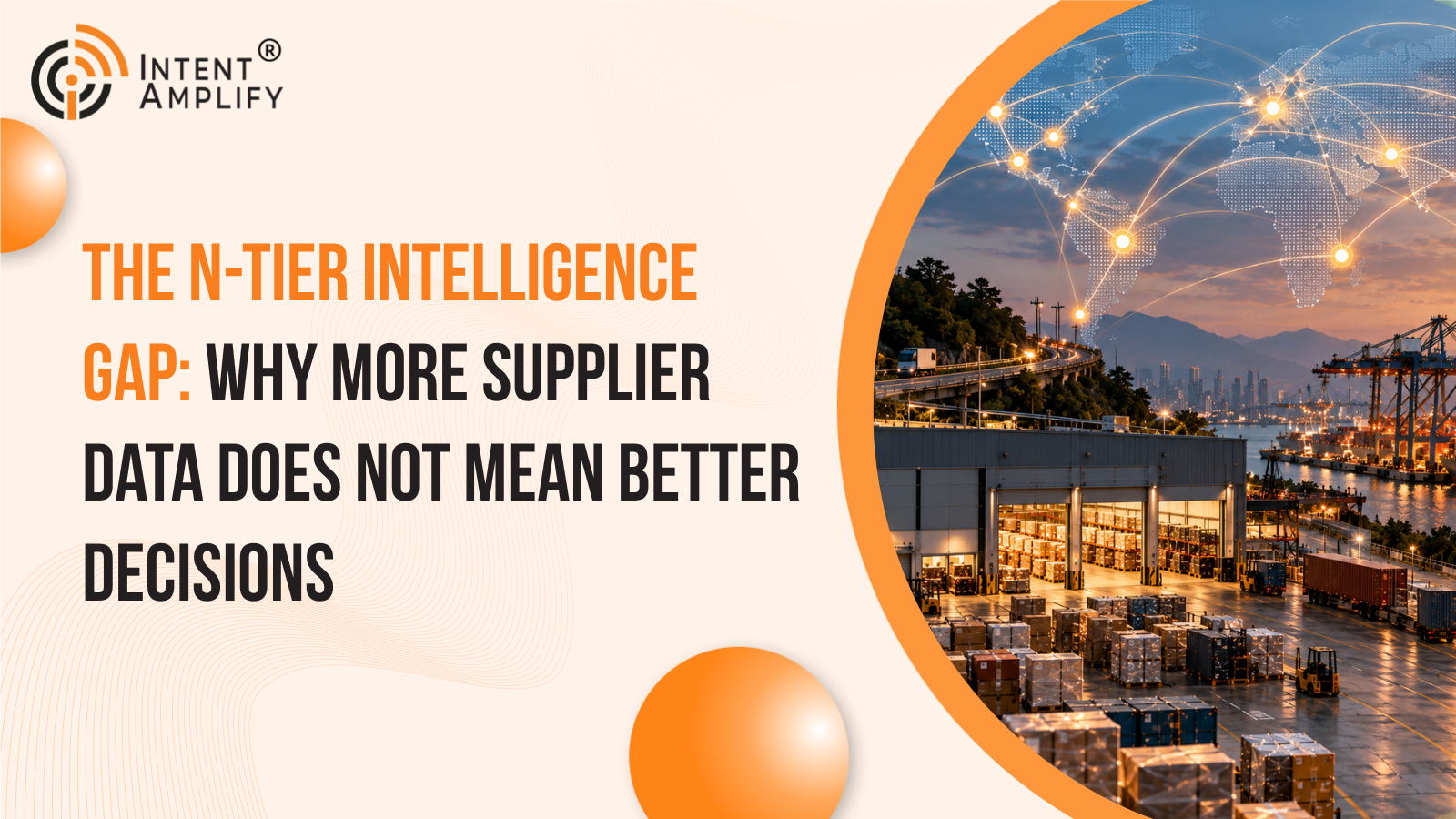
Supply chain transparency has a data problem, but not the one most leaders assume.
The obvious problem is missing data. Organizations often lack verified relationships beyond direct suppliers, and deeper-tier visibility remains uneven. Yet the opposite problem is becoming equally important: too much relationship data without enough decision context.
An N-tier program can map thousands of possible supplier connections and still fail to tell a procurement leader which product is exposed, which dependency is critical, what the potential business impact is, or what action should happen first.
The next maturity step is therefore not simply deeper mapping. It is decision-ready N-tier intelligence.
The difference between data coverage and decision coverage
Data coverage asks how much of the network is visible.
Decision coverage asks whether the organization can answer the questions required to act.
Those questions include:
- Which critical products depend on this supplier or site?
- Which direct suppliers share the same upstream dependency?
- How confident are we in the relationship?
- What risks are active?
- How quickly could disruption propagate?
- What mitigation options exist?
- Who owns the response?
A relationship that cannot be connected to a business decision may still be useful, but it should not carry the same priority as a verified dependency supporting a critical product.
Why relationship volume can create noise
AI and external data can accelerate discovery of potential supplier links. But inferred relationships must be governed carefully. A large graph can contain weak, outdated, or commercially irrelevant connections.
This creates two risks.
- First, false urgency. Teams may investigate relationships that do not materially affect the business.
- Second, false confidence. Leaders may assume a large map represents complete transparency even when the critical dependency is missing.
Sphera’s N-tier positioning emphasizes combining automated intelligence with human validation and maintaining organizational control over supplier selection and verification. That principle matters because the objective is not maximal data. It is usable confidence.
The product-centric alternative
A product-centric model reverses the sequence.
- Step 1: Identify the products, materials, or operations where disruption creates significant impact.
- Step 2: Map the supply paths that support them.
- Step 3: Identify shared upstream dependencies and concentration.
- Step 4: Monitor the risk categories that can affect those dependencies.
- Step 5: Define the mitigation decisions and ownership model.
This creates a narrower but more actionable intelligence layer.
The economics of attention
Supply chain risk teams operate with finite investigative capacity. Every alert consumes attention. Every supplier engagement requires time. Every alternate-source decision competes with other priorities.
The value of N-tier intelligence is therefore partly an allocation problem: direct attention toward the dependencies where earlier action can change the outcome.
That requires business context.
A risk signal becomes more valuable when it is connected to:
- product criticality,
- revenue or service exposure,
- inventory coverage,
- source substitutability,
- qualification lead time,
- geographic concentration,
- regulatory obligations,
- and customer commitments.
This context helps leaders prioritize response without pretending that every risk can be quantified perfectly.
The confidence layer
- Decision-ready N-tier intelligence should also communicate confidence.
- Verified relationship: supported by supplier confirmation or authoritative evidence.
- Strong signal: multiple credible sources indicate the relationship, but direct validation is incomplete.
- Weak signal: plausible connection requiring investigation.
- Unknown: insufficient evidence.
This prevents inferred data from being presented as fact and gives teams a rational order for validation.
Executive readiness framework
Decision scope
Which decisions will N-tier intelligence improve?
Business criticality
Which products, materials, sites, and commitments matter most?
Relationship quality
Can the organization distinguish verified, inferred, stale, and unknown relationships?
Concentration visibility
Can shared dependencies be identified across direct suppliers and products?
Impact context
Can risk be linked to operational, financial, compliance, or customer consequences?
Workflow ownership
Are triage, validation, supplier engagement, sourcing action, and escalation responsibilities defined?
Measurement
Can leaders track detection-to-decision time, mitigation completion, exposure reduction, and post-event outcomes?
The framework keeps the implementation focused on operating value rather than mapping scale.
What good looks like
A mature N-tier capability does not need to answer every possible question instantly. It should help teams reach a defensible decision faster.
When an upstream event occurs, leaders should be able to determine:
- whether the relationship is credible,
- which critical products are connected,
- whether the exposure is concentrated,
- what the likely propagation path is,
- what response options exist,
- and who owns the next action.
That is a higher standard than visibility. It is intelligence designed around action.
Watch the on-demand webinar
A useful operating test is whether additional supplier data changes a real decision. If a new relationship does not alter prioritization, validation, mitigation, sourcing, or escalation, its immediate value is limited. Decision-ready intelligence therefore favors relevance over volume, giving leaders enough trusted context to act while explicitly preserving uncertainty where evidence remains incomplete.
Unlocking N-Tier Intelligence for Better Supply Chain Decisions explores the transition from supplier-centric mapping to product-centric N-tier intelligence, with practical discussion of hidden dependencies, concentration risk, business impact, and action prioritization.
Watch the on-demand webinar: Unlocking N-Tier Intelligence for Better Supply Chain Decisions.
Connecting Complex Technology with Decision-Relevant Demand
Intent Amplify helps B2B technology brands translate complex capabilities into credible, executive-ready narratives. Our work supports content strategy, audience intelligence, demand activation, and account engagement across complex enterprise buying cycles.
Sources
1. Sphera, N-Tier Transparency.
2. Sphera (2025), N-Tier supply-chain transparency research announcement.
3. Sphera (2026), Why Traditional N-Tier Visibility Falls Short — and What Comes Next.
4. McKinsey & Company (2025), Supply Chain Risk Survey.
https://www.mckinsey.com/capabilities/operations/our-insights/supply-chain-risk-survey